




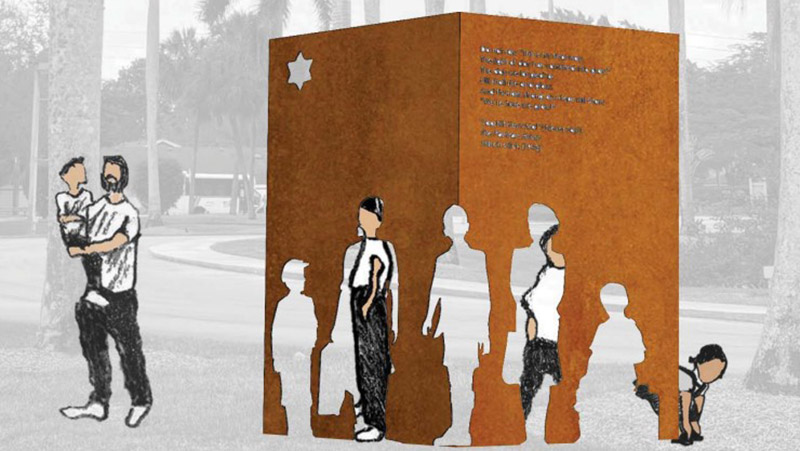
‘Generations’ by Marit Meisler
At first glance, the Holocaust monument appears weighty and solemn—dark plates of steel rising directly from the ground. But it is the sculpture’s empty spaces that give it meaning, inviting visitors to take part in a story reflecting the spirit and resilience of the Jewish people.
Cut into the metal of Coconut Creek’s soon-to-be-unveiled new memorial, titled Generations, are silhouettes representing the children murdered or orphaned during the Holocaust, and the countless lives shattered by Nazi persecution. Their absences reflect the singular impact of history’s deadliest genocide: As many as 1.5 million Jewish children alone were murdered or died at the hands of Nazi officials and their collaborators during the Holocaust, during which some six million Jews were killed.

And yet, as visitors move around the memorial, those voids are filled—briefly, quietly—with life.
This is the central idea behind Generations, which will be exhibited on the city’s Government Center plaza outside City Hall beginning January 29. The deeper story of the artwork stretches far beyond the city—across continents, across decades, and across the lives of one family shaped irrevocably by the Holocaust.

“Designing a Holocaust memorial is a profound challenge: finding a way to evoke emotion without being too literal, to honor history while connecting its meaning to our lives today,” Marit Meisler, the artist who created Generations, said in a presentation.

Marit is the daughter of Frank Meisler, a world-acclaimed sculptor and Holocaust survivor who escaped Nazi Europe as a child aboard the Kindertransport—the rescue mission that began nine months before the outbreak of World War II. The United Kingdom took in nearly 15,000 Jewish and non-Jewish children from Nazi Germany and occupied Europe, placing them in British foster homes, hostels, and farms.
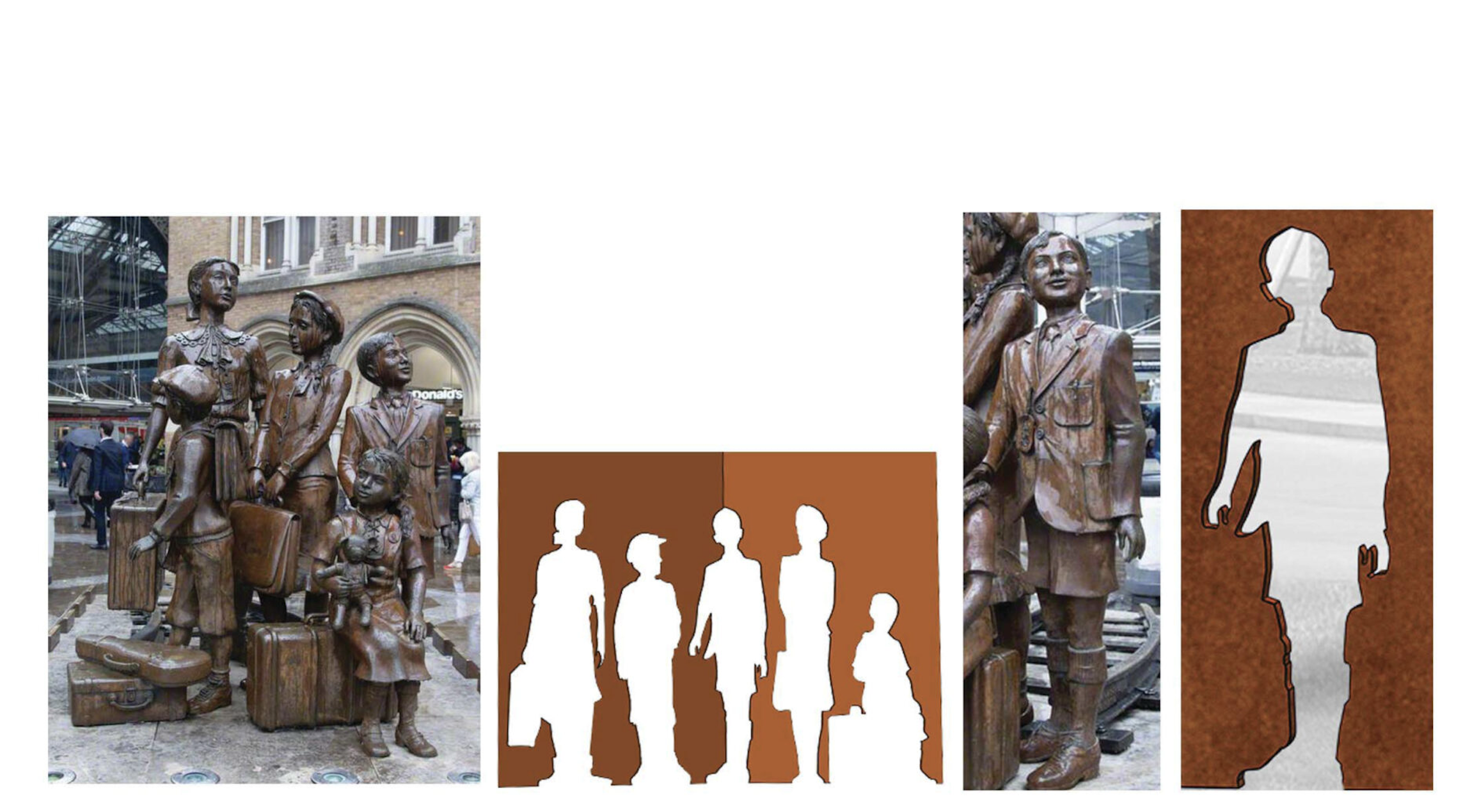
The figures of the children in ‘Generations’ are a direct reference to Frank Meisler’s ‘Kindertransport’ sculptures. One of the figures portrays Frank himself {Marit Meisler}.
Over a career spanning more than six decades, Frank created extraordinary public sculptures around the world, many of them focused on the Kindertransport experience. Five monuments he designed and erected in cities across Europe trace the story of the childrens’ journey, and stand today along their route to safety.

Frank Meisler, who never saw his parents after the Kindertransport, died in 2018.
In Generations, Marit Meisler drew directly from her father’s visual language. The silhouettes are a direct reference to Frank’s ‘Kindertransport’ sculptures. And in a moving tribute, one of the silhouettes rendered by Marit is Frank himself.
As adults and children walk around Generations, their bodies naturally align with the cutouts in the metal.

“Second, third, and fourth generations physically step into the spaces and the memory of those who perished,” Marit Meisler said. “In doing so, they complete the story, becoming a testament to survival, renewal, and hope.”
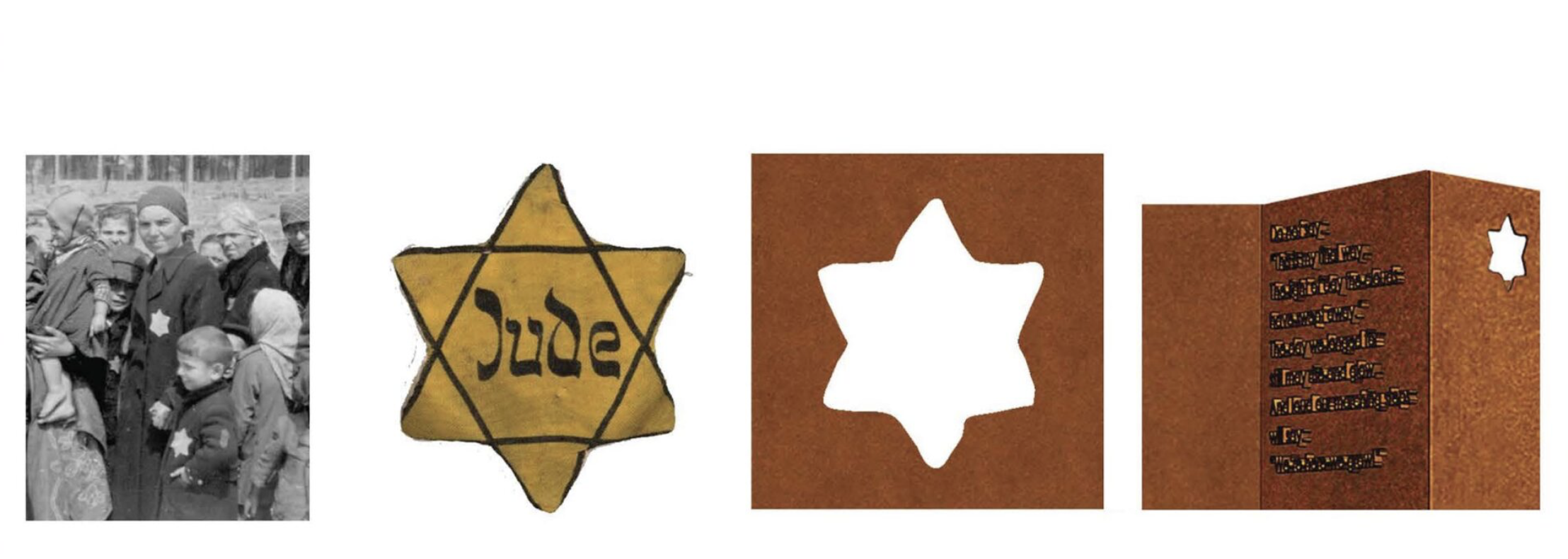
The Star of David in ‘Generations’ is shaped like the soft cloth stars worn in the Jewish ghettos {Marit Meisler}.
Among the monument’s most powerful details is a Star of David, shaped like the soft cloth stars Jews were forced to wear in ghettos.
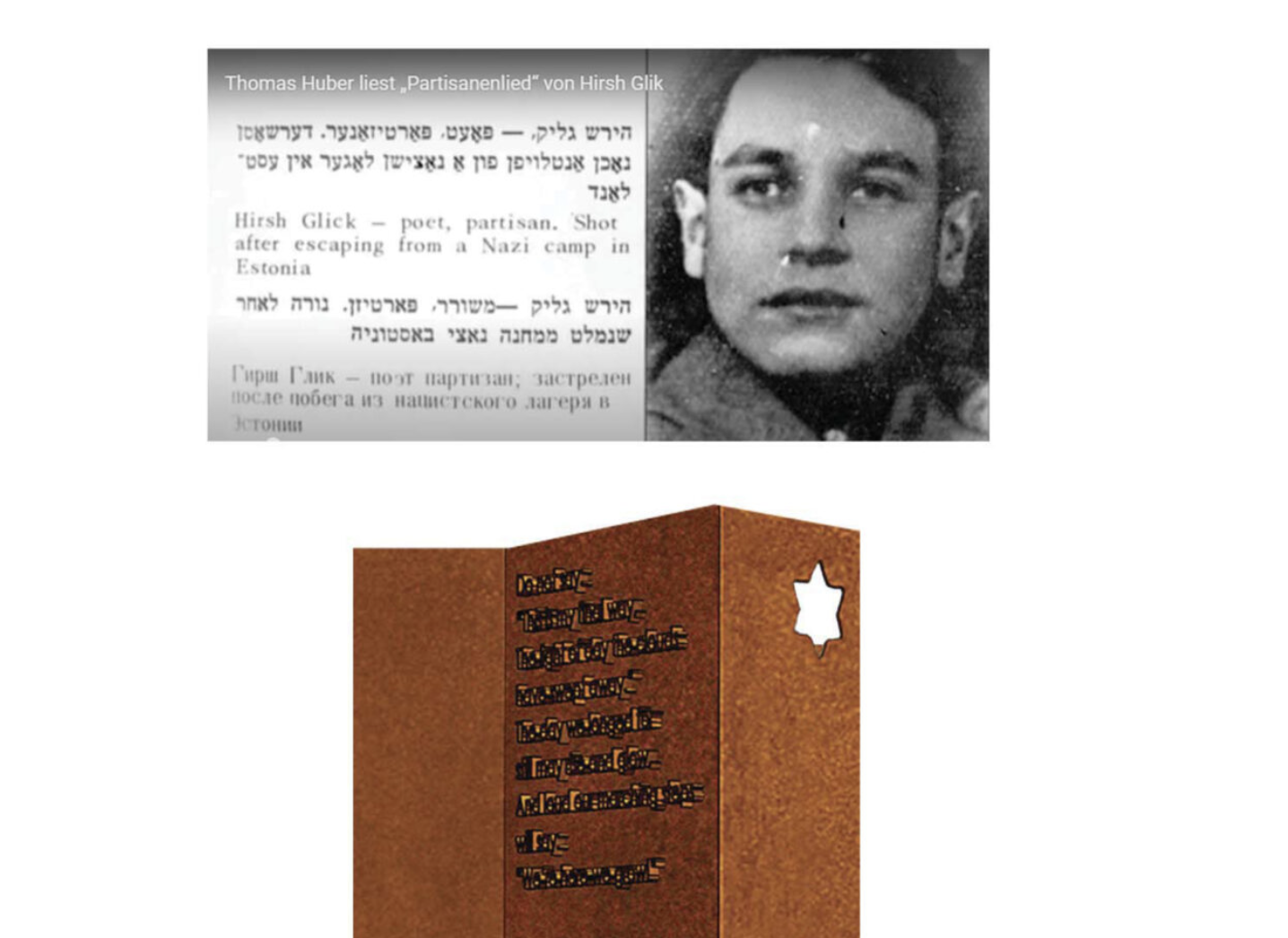
Etched into ‘Generations’ is a poem written in 1943 by Hirsh Glick, a young Jewish partisan whose words became an anthem of resistance during the Holocaust {Marit Meisler}.
Also etched into the metal is a poem written in 1943 by Hirsh Glick, a young Jewish partisan whose words became an anthem of resistance during the Holocaust.
The poem reads: “Do not say: ‘This is my final way, The light of day has vanished into gray!’ The day we longed for still shall rise and glow, And in our every step, we live – we grow!”
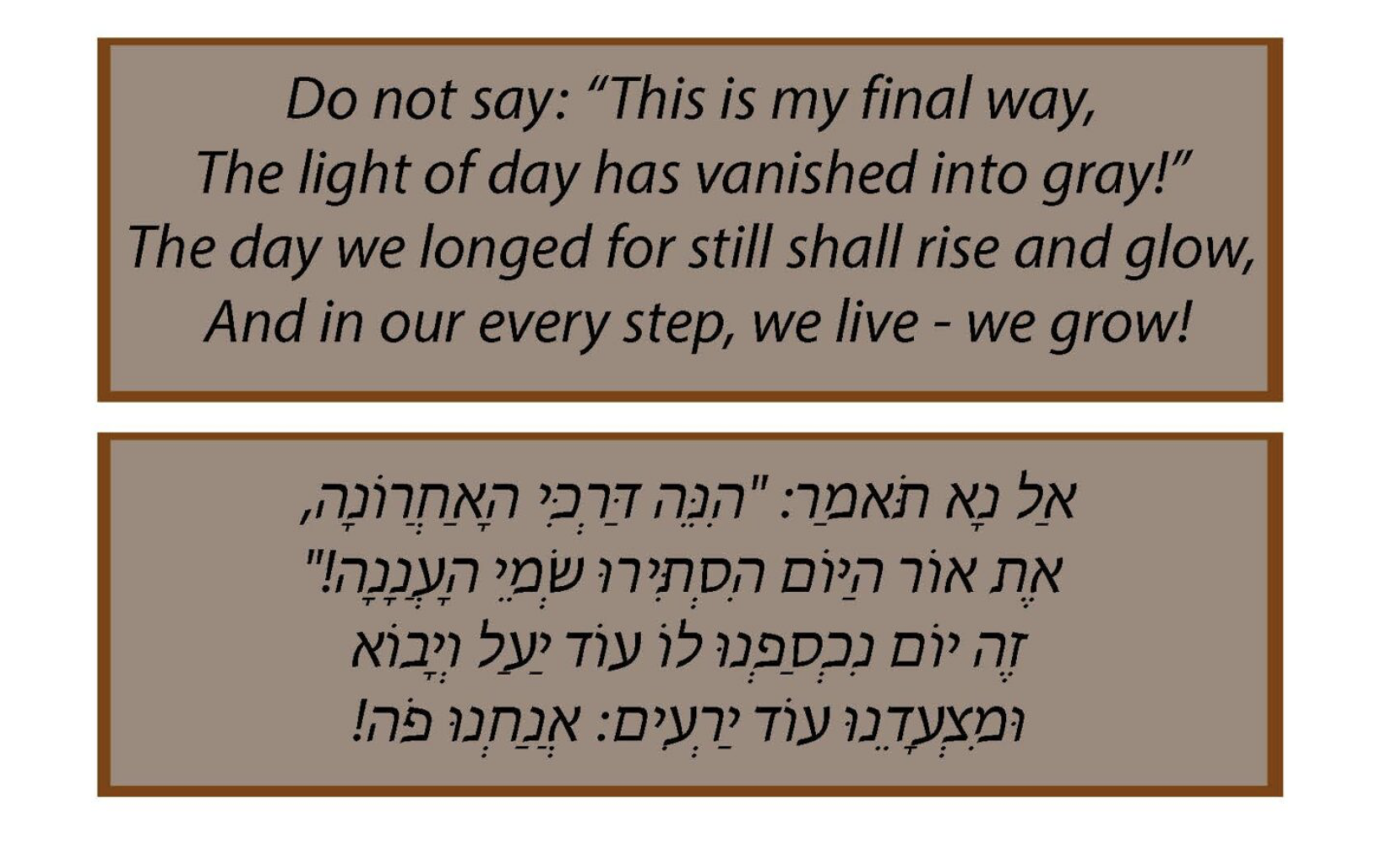
Hirsh Glick’s poem {Marit Meisler}.
In Generations, Glick’s words – etched in English and Hebrew – are meant to echo forward for generations yet to come.
“Hirsh’s prayer came true, we rose and we grew,” Marit Meisler said. “Today, the children who fill the empty voids of the sculpture. The second, third, and fourth generations stand as proof of our people’s resilience and victory.”
The public unveiling of the Holocaust memorial will be held Jan. 29 from 6:30 to 7:30 p.m., with limited seating, at Coconut Creek’s Government Center. To register, call 954-956-1580.
Got News in Coconut Creek? Send it Here. Don’t Miss reading NW Broward County’s #1 News Sites: Parkland Talk, Coconut Creek Talk, Coral Springs Talk, Margate Talk, Tamarac Talk, and Sunrise FL Talk.
Author Profile
Related
 EventsJanuary 11, 2026‘Generations’: How Coconut Creek’s New Holocaust Monument Honors Loss and Resilience
 Crime & SafetyJanuary 7, 2026Bomb Threats to Coconut Creek Schools Prompt North Broward Prep to Cancel Classes
 Crime & SafetyJanuary 5, 2026Broward ER Doctor Kills Woman in Coconut Creek, Then Takes His Own Life, Police Say
 Crime & SafetyDecember 22, 2025Coconut Creek Police Issue Scam Alert After Bank Fraudster Comes to Woman’s Home